04 April 2008

The Medium and the Message

Aaarg! I fear another one of these "chicken and egg" issues...

Vanessa, a member of my KS workshop asked this critical question:
What is the relationship between knowing your audience and communicating to them? If we want to communicate results to policymakers, the private sector and donors... do we take a different approach for each stakeholder? do we change the medium or just the message?
The message has to be tailored to the audience, this I believe just from my own professional experience. FAO’s technical publications on climate change are not suited to children studying climate change in grade school. Research journals on climate change may not necessarily give policy makers information in a form they can use for decision making. The impact of climate change is different from the perspective of a local NGO versus an international organization.

Personally I have been frustrated for years now by the question "WHO?" is responsible for tailoring all the information that is already readily available to those who need it. I’ve come to the conclusion it is something of a rhetorical questions resulting from varying levels of understanding of KM/KS principles amongst users, unequal allocation of KS resources, and a history of an “if we build it they will come” attitude about information management, amongst other things. Does anyone have a different take on this?

As for methods, this also needs to be "appropriate" as was noted in our workshop’s conference call this morning when someone raised the issue of how a choice of tools could actually bias the outcome of an exercise. (The example was mapping software in which it is intrinsically easier to create hub-and-spoke type relationships over other forms of networks.)

Personally I find that working on a computer is not conducive to group work. I'm not being a Luddite here! I just observe that for some reason when a group is around a computer most people tend to sit back and observe while the one or two people with their hands on the mouse do most of the actual thinking. Whereas working on a big sheet of paper with post-its is something that everyone can interact with simultaneously and thus there is more collaborative thinking. The computer-based tools are more useful for iterative work.

First hand experiencing with these is what we really need to start making informed choices. Thank goodness for workshops like this one that I’m in. Networks of practitioners were also pointed out as good ways to get experience with some of the methods. For example:
http://www.theworldcafe.net
http://www.openspaceworld.org

This is a very complicate subject, and something I need to look into and learn more about with the help of my colleagues and friends.

03 April 2008

The Individual or the Organization: Which Matters for Effective Knowledge Sharing?

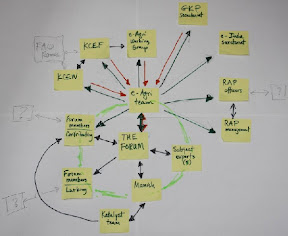
In the KS workshop we had an exercise to map a network (see the image of my work below). I chose to map a network in the e-Agriculture community that I am working with, based on an online forum/discussion group. It may go down in the history books as "easier said than done"!


One of the major challenges was deciding whether to map individuals, organizations, or some combination of both. In the end I have a combination, a combination that changed as I progressed through the assignment. Ultimately I chose to go with more organizational groups and fewer individuals mainly to make mapping different lines of communication a simpler process. But then this led to questions, and more questions by a colleague and facilitator.

1) What about the individuals & related communication flows we know exist, but cannot "see" and thus cannot map?
2) What are the pros, cons of mapping individuals versus mapping organizations/groups?
3) What happens to the lines in a map when an individual moves in/out of a particular position within an organization?

I think the answer to question 1 is that these can be elucidated by different means, so part of the exercise is determining if it is necessary/worthwhile to make the effort.

Points 2 and 3 are interlinked. But I'm having a hard time rationalizing the individual/organization relationship. I think (but need some help on this) that it's the individual that is responsible for the communication/KS so that the individual is key. And that individuals moving from position to position (inter- or intra-organizationally) move their communication lines with them, but by necessity evolve those lines based on their new environment. Thus the organization is the environment ... enabling or otherwise. Hmm....

31 March 2008

Sharing Knowledge with me and others (a course!)

I am currently a participant in a workshop on knowledge sharing (KS) techniques supported by CGIAR and facilitated by four great individuals. A professional development opportunity!! Wonderful.

For this workshop I personally have two goals: to develop my understanding of good KS and my ability to apply KS tools; and, to expand my network of professionals working in the KS/KM field. I want to improve myself and be able to do a better job at my work, but I also know that I can never do it all nor do I work in a vacuum. (But it does get lonely out here some times!) The network of professional friends is what really brings it all together in the end.

The success of this could be judged through my application of the things we learn in my work and hopefully through the identification of some common interests (maybe even specific projects?) with others who are taking the course with me.

The course is run in a space on the net created with Moodle. This in itself is a learning experience for me, as I know about this application from our IMARK team, but have not actually experienced it first hand! The learning space is choc (hey, that’s a Nancy White term isn’t it?!) FULL of stuff and we’re just though our first week. It’s fascinating and a bit overwhelming at the same time. All the things I don’t know laid out in front of me … and then there’s trying to balance this opportunity to learn new things with the day-to-day demands of my regular work. I will mange :-D

LEARNING! Never stop learning.

(This is the first of several posts that I will be making during the online KS workshop.)

12 March 2008

Collaboration and Advocacy Techniques Course Online

Never stop learning! Opportunties to learn at our own pace and for free, to upgrade our own skills and knowledge are increasing. This is one excellent opportunity for people working in development, especially related to food security.

"Collaboration and Advocacy Techniques," a new e-learning course including resources for trainers and practical guides, has been released by the EC-FAOFood Security Programme in collaboration with the Overseas DevelopmentInstitute's (ODI) Research and Policy in Development (RAPID) Programme andWomen Thrive Worldwide.

This course illustrates a wide range of tools and techniques that can be usedto improve collaboration and knowledge sharing, and provides guidance onconducting collaborative food security assessments. The course alsointroduces the concept of advocacy and the various advocacy techniquesrequired to influence different audiences.

The course is available free of charge on-line and on CD-Rom.

How to Access the Course and Related Materials

To access the e-learning course on-line, go to:
http://www.foodsec.org/DL/dlregistration_en.asp
To download the resources for trainers, go to:
http://www.foodsec.org/tr_res_07.htm
To access the practical guides, go to:
http://www.foodsec.org/pubs_km.htm

If you have problems with on-line access, order a CD-Rom at:
http://www.foodsec.org/DL/dlorder_en.asp?modulecode=FK&modulelang=en

05 March 2008

e-Agriculture and Public-Private Partnerships Forum

I’ve been lucky enough to meet quite a few dynamic, intelligent, dedicated people in my life. There were a whole lot of people with these qualities at the GKP Event on the Future, Third Global Knowledge Conference (GK3) last December in KL. Through events like the special panel on “e-Agriculture: Continuing Dialogue to Action” there were many ideas that began to form and one is now ready to be launched!

e-Agriculture.org is hosting an online forum "Making e-Agriculture Work through Public Private Partnership (PPP) in Asia" 10-28 March 2008. It is open to everyone and I encourage you to join, participate, voice your thoughts, share your experiences, and take in the ideas and experiences of others dedicated to ICT4D in the region.

The forum has a super team of experts and moderators including Dr. M. Asaduzzaman from BIDS, Bangladesh; Amit Dasgupta, General Manager of IBM Global Services India; Philip DesAutels, Academic Evangelist at Microsoft; Naimur Rahman, Director of OneWorld South Asia; Sunit Shrestha, Director of TNR Institute; Manish Pandey of Katalyst; and Charlotte Masiello-Riome, WSIS focal point for e-agriculture. Oh, and me too! A little bit of self-promotion is ok isn't it? ;-)

For more information and sign-up go to http://www.e-agriculture.org/

26 February 2008

ICT and the Climate Crisis

I just saw a presentation by Stuart Scott (who was trained by Al Gore) on "the Climate Crisis". This is the second time in two days I have been involved in a discussion on this important topic and it has me thinking about ways that ICT4D can have positive impact on this. Mr Scott has a website at http://www.climatecorps.org/, that alone is indication that ICT plays some role in moderating, if not abating, the climate crisis!

Agriculture has a key role in climate change, no question there. ICT on the other hand is not yet in the forefront on this subject. From what little I have read on the subject, ITC industries have a relatively low greenhouse gas emission levels. That's good (if it's correct). Still more interesting (at least to me and maybe to the broader community?) is ICT's potential as a potent mitigator of climate change. At first glance it would seem there are several levels on which this can occur: reducing the need for travel, fascilitating dissemination of appropriate knowledge in a timely manner, monitoring change/impact, providing ability to analyze at multiple levels (from local to global).

There's also the question of how do we improve livelihoods without further negatively impacting the climate? The culture of change and changing cultures. Let's think on this one.

29 January 2008

Design and Development - Sharing Ideas

At the World Economic Forum discussions encompass many topics, including the design field. A panel of four prominent thought leaders in the design field spoke on their expectations for the future, and I find some of these ideas not only interesting but applicable to the development field.

Rarely do I hear design and development spoken of at the same time, but I think there is something each field can learn from the other. After all, what are we all looking for but solutions to a problem?

In particular I found the comments by John Maeda, President of RISD, relevant. He indicated there needs to be an increased transparency in design (in fact noting the processes of developing open-source software as a model that had applications in the design field), simplicity and the goal of simplification, and finally the importance of finding beauty (or something good) in every day things. To me all three of these concepts are directly relevant to improving information management projects for development.

An article about this event can be found online in the International Herald Tribute article by Alice Rawsthorn at http://www.iht.com/articles/2008/01/25/arts/design28.php