For some time now I have been bothered by my own inability to organize the increasing number of online networking and sharing tools. It's not that they are not all great in their own right (well at least some of them), but there are days when it's hard to know what's/who's where. Today I found out from @mobileactive (thank you!) about a simple tool called UnHub which allows one to create a single profile and put all the URLs of their various online presences in there. You can list websites, Twitter, blogs, Flickr, RSS, etc. It's simple, easy to use, and I think a very neat little tool. My UnHub is at http://unhub.com/mongkolroek
PS: President Obama is already on UnHub! It is so hard to keep up these days.
Showing posts with label knowledge_sharing. Show all posts
Showing posts with label knowledge_sharing. Show all posts
19 March 2009


19 January 2009
Sharing via Social Media Tools at ShareFair09
For everyone who's interested in following the Knowledge Share Fair, but cannot attend in person, there will be a large contingent of participants using social networking tools to leverage the experience. You can find these two ways:
1) Look at the official Share Fair sites as follows:
2) Search for the contributions of the many in attendance using the Share Fair tag "sharefair09" or "#sharefair09" on Twitter.
Final preparations are all coming together now! It promises to be a watershed event ;-)

1) Look at the official Share Fair sites as follows:
- Blip.tv http://sharefair.blip.tv/
- Flickr http://www.flickr.com/groups/sharefair09/
- Delicious http://delicious.com/sharefair09/
- Twitter http://twitter.com/sharefair09/
- Blogger http://sharefair2009.blogspot.com/
2) Search for the contributions of the many in attendance using the Share Fair tag "sharefair09" or "#sharefair09" on Twitter.
Final preparations are all coming together now! It promises to be a watershed event ;-)

15 January 2009
Sharing Knowedge about Knowledge Sharing for Development
The Knowledge Share Fair for Agricultural Development and Food Security (otherwise known as "Share Fair"), being jointly organized by Bioversity International, the CGIAR ICT-KM program, FAO, IFAD and WFP, will take place next week over three days at FAO Headquarters from 20 to 22 January 2009.
This promises to be a unique, exciting event for the organizers and those in attendance, including me! It is the first time (to my knowledge) that all these international organizations - organizations in which the greatest asset is information and knowledge - will come together to discuss specifically about sharing knowledge, about making knowledge more powerful, more effective, and through this making rural development more successful and sustainable. I'm also very much looking forward to reconnecting with friends and colleagues, meeting some of my virtual collaborators in person for the first time, and expanding my KM4D network!
The Shair Fair will focus on methods, tools, lessons learned, challenges, partnerships, etc. of knowledge sharing, so as to provide practices and learning opportunities that will be of practical benefit to the multi-disciplinary audience. The achievements of projects, programmes and divisions will be presented in light of demonstrating successful knowledge sharing. There will also be special sessions applying new Web2 tools.
There is a great, short video clip on Blip.TV in which Roxana Samii, IFAD, talks about looking forward to this event. Check it out!
I will be taking direct part in four sessions:
Registration for the Share Fair is already open online. For those who can't be there, keep a look out for posts, blogs, tweets, blips, etc. on the event all next week using the "sharefair09" tag.
This promises to be a unique, exciting event for the organizers and those in attendance, including me! It is the first time (to my knowledge) that all these international organizations - organizations in which the greatest asset is information and knowledge - will come together to discuss specifically about sharing knowledge, about making knowledge more powerful, more effective, and through this making rural development more successful and sustainable. I'm also very much looking forward to reconnecting with friends and colleagues, meeting some of my virtual collaborators in person for the first time, and expanding my KM4D network!
The Shair Fair will focus on methods, tools, lessons learned, challenges, partnerships, etc. of knowledge sharing, so as to provide practices and learning opportunities that will be of practical benefit to the multi-disciplinary audience. The achievements of projects, programmes and divisions will be presented in light of demonstrating successful knowledge sharing. There will also be special sessions applying new Web2 tools.
There is a great, short video clip on Blip.TV in which Roxana Samii, IFAD, talks about looking forward to this event. Check it out!

I will be taking direct part in four sessions:
- K for Institutions and Partnerships: "Public-Private Partnerships: Cross-fertilisation of Knowledge"
- K for Networks and Communities of Practice: "Leveraging Connections among Networks"
- K for Rural Communication: "Mobile Telephony in Rural Areas"
- K for Institutions: "Making Networks Work Within Institutions"
Registration for the Share Fair is already open online. For those who can't be there, keep a look out for posts, blogs, tweets, blips, etc. on the event all next week using the "sharefair09" tag.
29 October 2008
"Mobile Telephony in Rural Areas" 17-28 November 2008 online forum at www.e-agriculture.org
Mobile phones are the success story of bridging the rural digital divide, bringing tangible economic benefits and acting as agents of social mobilization through improved communication. But what are the real challenges that face reaching rural areas, and what are some of today’s most beneficial applications that can help these rural communities, specifically regarding agriculture development?
This Forum will examine the challenges that rural communities face in enhancing the benefits of mobile telephony, and look at some examples of interesting initiatives and good outcomes from around the globe.
Subject Matter experts include:
with
Charlotte Masiello-Riome, Communications Expert and e-Agriculture.org Coordinator
Michael Riggs, Information Management Specialist for the Asia-Pacific region, Food and Agriculture Organization of the United Nations
Register on the e-agriculture platform, if you haven’t already done so. Go to http://www.e-agriculture.org/regform.html
This Forum will examine the challenges that rural communities face in enhancing the benefits of mobile telephony, and look at some examples of interesting initiatives and good outcomes from around the globe.
Subject Matter experts include:
- Pete Cranston, ICT and New Media in Development Consultant
- Jawahar Kanjilal, Global Head of Emerging Market Services, Services & Software, Nokia
- Christian Kreutz, Consultant, Knowledge Activist
- AHM Sultanur Reza, Additional General Manager and Head, Community Information Center, Grameenphone Ltd.
- Luca Servo, Communication for Development Consultant, Research and Extension Division, Food and Agriculture Organization
- Nigel Scott, Gamos
with
Charlotte Masiello-Riome, Communications Expert and e-Agriculture.org Coordinator
Michael Riggs, Information Management Specialist for the Asia-Pacific region, Food and Agriculture Organization of the United Nations
Register on the e-agriculture platform, if you haven’t already done so. Go to http://www.e-agriculture.org/regform.html
05 September 2008
Sharing the events of last week's IAALD-AFITA-WCCA World Congress with the tag "aginfo8"
So many interesting things transpired at the World Congress in Japan last week that I have been struggling with what to write about next! With time slipping away as it does, I've suddenly realized the efficient issue is to make sure everyone interested is aware of the tag "aginfo8".
Just search the tag in your favorite search engine, or use it in any of the web2 applications that were used by the organizers and several participants at the event (Flickr, Feedburner, Slideshare, Delicious, etc.) and you'll find loads of great information from presenters' slides to commentary from the audiences.
For those who prefer a more direct approach, here is a list of resources kindly provided by Peter Ballantyne and the Euforic web 2 team:
My congratulations to the three organizations as well as the hosts in Japan for an excellent job in organizing this event and providing an opportunity for sharing and learning. As a final note, the next IAALD meeting will be in Montepellier, France in 2010.
Just search the tag in your favorite search engine, or use it in any of the web2 applications that were used by the organizers and several participants at the event (Flickr, Feedburner, Slideshare, Delicious, etc.) and you'll find loads of great information from presenters' slides to commentary from the audiences.
For those who prefer a more direct approach, here is a list of resources kindly provided by Peter Ballantyne and the Euforic web 2 team:
- general news feed: http://feeds.feedburner.com/aginfo8
- some stories: http://iaald.blogspot.com/search/label/aginfo8
- some photos: http://www.flickr.com/groups/749287@N20/
- some presentations: http://www.slideshare.net/tag/aginfo8
- some video interviews: http://iaald.blip.tv/
- everything bookmarked together at http://delicious.com/tag/aginfo8
My congratulations to the three organizations as well as the hosts in Japan for an excellent job in organizing this event and providing an opportunity for sharing and learning. As a final note, the next IAALD meeting will be in Montepellier, France in 2010.
26 August 2008
The Challenges of Reaching Individuals with Information
Setting the stage on day one of the IAALD-AFITA-WCCA World Congress
On the first day of the IAALD-AFITA-WCCA World Conference, Peter Ballantyne proposed a question to unify and focus our thoughts over the duration of this conference, “How can we make agricultural information and IT truly accessible?”
An excellent keynote presentation by Fedro Zazueta (University of Florida) reviewed the development of online education, in which he characterized new means of disseminating information and knowledge sharing as “connected, fast, smart, alien and deeply disruptive”! I found the last two adjectives the most critical and deserving of consideration, as I think it is something we IM/KM professionals tend to lose sight of. Even in developed countries, new technologies for information delivery can create stresses at both the individual and organizational level which were not present before the paradigm shifts we are experiencing in this information age. In developing countries, how much more alien and disruptive can this be?
These issues were picked up in a slightly different light in the presentation by Luz Marina Alvare on how IFPRI has recognized that different generations and disciplines both respond to and access information in very different ways. The situation poses several challenges, both from the need to reach all these generations and disciplines, as well as to managing the concerns that arise from the different dissemination and knowledge sharing methods used. In particular it is necessary to address concerns about the risk versus the value of web2.0 tools, which are still not widely appreciated or supported by positive data. As we might expect, the younger generations are more responsive to information delivered in web2.0 applications, as are certain disciplines such as journalists who like to glean information from blogs.
Prof. Mei Fangquan (Chinese Academy of Agricultural Sciences) focused his keynote on ICT4D strategy in China and emphasized the challenges of the “first mile” of connectivity and providing locally relevant content, an issue that was echoed and developed in many of the papers presented later that day.
On the first day of the IAALD-AFITA-WCCA World Conference, Peter Ballantyne proposed a question to unify and focus our thoughts over the duration of this conference, “How can we make agricultural information and IT truly accessible?”
An excellent keynote presentation by Fedro Zazueta (University of Florida) reviewed the development of online education, in which he characterized new means of disseminating information and knowledge sharing as “connected, fast, smart, alien and deeply disruptive”! I found the last two adjectives the most critical and deserving of consideration, as I think it is something we IM/KM professionals tend to lose sight of. Even in developed countries, new technologies for information delivery can create stresses at both the individual and organizational level which were not present before the paradigm shifts we are experiencing in this information age. In developing countries, how much more alien and disruptive can this be?
These issues were picked up in a slightly different light in the presentation by Luz Marina Alvare on how IFPRI has recognized that different generations and disciplines both respond to and access information in very different ways. The situation poses several challenges, both from the need to reach all these generations and disciplines, as well as to managing the concerns that arise from the different dissemination and knowledge sharing methods used. In particular it is necessary to address concerns about the risk versus the value of web2.0 tools, which are still not widely appreciated or supported by positive data. As we might expect, the younger generations are more responsive to information delivered in web2.0 applications, as are certain disciplines such as journalists who like to glean information from blogs.
Prof. Mei Fangquan (Chinese Academy of Agricultural Sciences) focused his keynote on ICT4D strategy in China and emphasized the challenges of the “first mile” of connectivity and providing locally relevant content, an issue that was echoed and developed in many of the papers presented later that day.
20 August 2008
Twitter Trials entry Two
Well I've been using Twitter for several days now ... my initial impression is it is a potentially powerful knowledge sharing tool for those who can make full use of the application, i.e. those who can easily (and inexpensively) send and receive "tweets," particularly real time.
However as I've discovered in many countries, my home base Thailand being one of them, there is no way to receive SMS-based tweets on one's cellphone. It is possible using cellphone apps that take advantage of EDGE or similar data transfer protocols, but this introduces a different cost factor. After reading a bit I decided to install Twitteriffic on my iPhone, which has been easy to use and seems to be a decent application for tweeting. However, I have yet to decide I want to pay for a higher level of data transfers using my provider's EDGE service. This would be necessary if I use Twitteriffic very much.
My iPhone won't work at all from Japan next week, where I will be attending the IAALD-AFITA-WCCA World Congress. However, I will attempt to tweet from my laptop - I was inspired by Nancy White's tweets from a meeting in New Zealand this week. Just one more element of my own personal "Twitter trials".
However as I've discovered in many countries, my home base Thailand being one of them, there is no way to receive SMS-based tweets on one's cellphone. It is possible using cellphone apps that take advantage of EDGE or similar data transfer protocols, but this introduces a different cost factor. After reading a bit I decided to install Twitteriffic on my iPhone, which has been easy to use and seems to be a decent application for tweeting. However, I have yet to decide I want to pay for a higher level of data transfers using my provider's EDGE service. This would be necessary if I use Twitteriffic very much.
My iPhone won't work at all from Japan next week, where I will be attending the IAALD-AFITA-WCCA World Congress. However, I will attempt to tweet from my laptop - I was inspired by Nancy White's tweets from a meeting in New Zealand this week. Just one more element of my own personal "Twitter trials".
14 August 2008
The Twitter Trials
OK who out there is using Twitter?
Although I have been aware of it and done some reading about it, I'll admit to being a lagging adopter in this case. I even brought it up in the KS course I took earlier this year to learn more about it, but still didn't join. Then today I read some blogs on Twittering by
So today I signed up for Twitter. My ID is "mongkolroek" if you are interested in following me there...
Really what I want to know is how Twitter will be useful for me and also for the communities I am working with. There is a growing interest in the use of mobile phones in the ICT4D field. The interest in, indeed the use of mobiles in the development field is not new. It seems the frequency of mobile phones coming up in discussions I've had with colleagues and partners, and posts I've seen online here and there have increasingly referenced the use of mobiles. Maybe there's now a wider acceptance of their importance, and/or the service is more widely available/affordable, and/or an expansion of functions beyond managing price data, and/or maybe something else.
If anyone can point me to some good information about the value of mobile phones in ICT4D (in practice or theoretical) that would be great.
Although I have been aware of it and done some reading about it, I'll admit to being a lagging adopter in this case. I even brought it up in the KS course I took earlier this year to learn more about it, but still didn't join. Then today I read some blogs on Twittering by
So today I signed up for Twitter. My ID is "mongkolroek" if you are interested in following me there...
Really what I want to know is how Twitter will be useful for me and also for the communities I am working with. There is a growing interest in the use of mobile phones in the ICT4D field. The interest in, indeed the use of mobiles in the development field is not new. It seems the frequency of mobile phones coming up in discussions I've had with colleagues and partners, and posts I've seen online here and there have increasingly referenced the use of mobiles. Maybe there's now a wider acceptance of their importance, and/or the service is more widely available/affordable, and/or an expansion of functions beyond managing price data, and/or maybe something else.
If anyone can point me to some good information about the value of mobile phones in ICT4D (in practice or theoretical) that would be great.
16 July 2008
Looking Towards e-Agriculture at eIndia 2008!
The next main ICT4D event in this region will be eIndia 2008, 29-31 July, in New Delhi.
In the eAgriculture track at eIndia, FAO, GKP and OneWorld South Asia have teamed up to bring some of the brightest minds in KM4D and ICT4D together at this event, people dedicated to improving rural development. The group will discuss some new topics, shine the light on some challenges, and see what innovative ideas the collective group can identify for acting on in the near future.
There will be a headline presenation on the global e-Agriculture initiative and the growing importance of the e-agriculture.org platform in Asia-Pacific.
On Wednesday, 30 July there will be a panel discussion on "Making e-Agriculture work through public-private partnership in Asia."Public private partnerships (PPPs) in e-Agriculture are generally found at the community level where the strengths of the public and private sectors complement each other in providing information and advisory services that address the needs of farmers and rural communities. Examples of PPP in e-Agriculture abound in Asia-Pacific, and range from establishing access points (e.g. cybercafés, telecenters) to generation and delivery of content through mobile phones (SMS) and the internet. Understanding why a PPP is required, the respective mandates and incentives of the partners, and their roles in the partnership, are fundamental to its success. This face-to-face event builds on the March 2008 online forum hosted by www.e-agriculture.org with an audience led discussion on how to further this understanding, and to identify opportunities for collaboration.
Panelists:
- Dr. Alexander Flor, Dean & Professor, Faculty of Information and Communication Studies, University of the Philippines Open Univ.
- Mr. Michael Riggs, e-Agriculture.org
- Mr. Rikin Gandhi, Assistant Researcher, Microsoft Research India; Founding Member, Digital Green
- Dr. (Ms) Prema Ramchandran, Director, Nutrition Foundation of India
Moderated by Ms. Shalini Kala, IDRC, ENRAP coordinator
And so much more!! It's a chance to listen, learn, speak, meet and network ... all key to personal knowledge sharing! I hope to see you there. Do come up and say "hi" when you see me! ;-)
In the eAgriculture track at eIndia, FAO, GKP and OneWorld South Asia have teamed up to bring some of the brightest minds in KM4D and ICT4D together at this event, people dedicated to improving rural development. The group will discuss some new topics, shine the light on some challenges, and see what innovative ideas the collective group can identify for acting on in the near future.
There will be a headline presenation on the global e-Agriculture initiative and the growing importance of the e-agriculture.org platform in Asia-Pacific.
On Wednesday, 30 July there will be a panel discussion on "Making e-Agriculture work through public-private partnership in Asia."Public private partnerships (PPPs) in e-Agriculture are generally found at the community level where the strengths of the public and private sectors complement each other in providing information and advisory services that address the needs of farmers and rural communities. Examples of PPP in e-Agriculture abound in Asia-Pacific, and range from establishing access points (e.g. cybercafés, telecenters) to generation and delivery of content through mobile phones (SMS) and the internet. Understanding why a PPP is required, the respective mandates and incentives of the partners, and their roles in the partnership, are fundamental to its success. This face-to-face event builds on the March 2008 online forum hosted by www.e-agriculture.org with an audience led discussion on how to further this understanding, and to identify opportunities for collaboration.
Panelists:
- Mr. Amit Dasgupta, IBM Global Services India
- Mr. Manish Pandey, Deputy General Manager , Katalyst-Swisscontact
- Mr. Naimur Rahman, Director, OneWorld South Asia
- Mr. Manish Pandey, Deputy General Manager , Katalyst-Swisscontact
- Mr. Naimur Rahman, Director, OneWorld South Asia
- Dr. (Mr) N.T. Yaduraju, NAIP/ICAR
- Dr. (Ms) Amrita Patel, Chairman, National Dairy Development Board (TBC)
- Dr. (Ms) Amrita Patel, Chairman, National Dairy Development Board (TBC)
Moderated by Michael Riggs, FAO
On Thursday, 31 July there will be a panel discussion on "The role of communities of practice (COP) and networks in e-Agriculture." COP strengthen links between networks of practitioners, allow individuals to gather and gain access to policy and technical information, facilitate sharing and exchange of complementary knowledge and resources, and can organize and create knowledge in ways that are flexible. Following up the World Summit on the Information Society (WSIS) plan of action, the e-Agriculture Working Group conducted a global survey on "e-agriculture". The need for networks of experts and a community of practice was high on the resulting list of actions. This panel representing some of the leading COP in Asia that are active through virtual collaboration spaces, face-to-face events, and in-country interventions. The panel will interact with the audience to analyze what role COP play and what value they bring to the application of e-Agriculture and through that successful, sustainable rural development in the region.
Panelists:
- Dr. Gopi Ghosh, Assistant FAO Representative, and Solution Exchange India network coordinatorOn Thursday, 31 July there will be a panel discussion on "The role of communities of practice (COP) and networks in e-Agriculture." COP strengthen links between networks of practitioners, allow individuals to gather and gain access to policy and technical information, facilitate sharing and exchange of complementary knowledge and resources, and can organize and create knowledge in ways that are flexible. Following up the World Summit on the Information Society (WSIS) plan of action, the e-Agriculture Working Group conducted a global survey on "e-agriculture". The need for networks of experts and a community of practice was high on the resulting list of actions. This panel representing some of the leading COP in Asia that are active through virtual collaboration spaces, face-to-face events, and in-country interventions. The panel will interact with the audience to analyze what role COP play and what value they bring to the application of e-Agriculture and through that successful, sustainable rural development in the region.
Panelists:
- Dr. Alexander Flor, Dean & Professor, Faculty of Information and Communication Studies, University of the Philippines Open Univ.
- Mr. Michael Riggs, e-Agriculture.org
- Mr. Rikin Gandhi, Assistant Researcher, Microsoft Research India; Founding Member, Digital Green
- Dr. (Ms) Prema Ramchandran, Director, Nutrition Foundation of India
Moderated by Ms. Shalini Kala, IDRC, ENRAP coordinator
And so much more!! It's a chance to listen, learn, speak, meet and network ... all key to personal knowledge sharing! I hope to see you there. Do come up and say "hi" when you see me! ;-)
21 May 2008
ICT and the Generations
I found a very interesting article "Ten Reasons Gen Xers are Unhappy at Work" (It comes from the author's larger group of online discussions on Gen X and Y management issues. The site is a new find for me, and as I find it quite interesting I am sharing.)
By the way, I guess I should divulge that I am part of Gen X.
We will get to ICT, but first let me say it is very interesting to read analysis about managing different generations. If one generalizes about my workplace, my superiors are mostly Boomers, my peers are Gen X, and the newer staff are Gen Y. Quite a conundrum!
Recently I was told that Gen Y has proclaimed itself renamed the "Millennium Generation." Hmm ... I mean they were hardly even old enough to worry about their Windows files exploding on the "doom" date of 01/01/00!
Getting back to the issue at hand, there are some very useful tidbits - points 5, 6 & 8 - in this article about how the different generations relate to new technologies and also how they communicate. Both of these issues are critical to successful application of ICT for development (or in any context really). It may be possible to argue this is written from a the perspective of a western manger, and while I agree adamantly that awareness and understanding of cultural context is critical, I still find the considerations and sensitivities made apparent by this author's writings applicable here in Asia.
We must be aware of how different groups of people relate to each other and to technology. Generalizations are useful tools in developing models to handle such situations (and as such I disagree with some of the detractors of this article). We have to start somewhere, and an informed generalization combined with experience and skill (wisdom?!) can lead to the successful adaption of good ICT4D models in our day-to-day, real world projects and programs.
By the way, I guess I should divulge that I am part of Gen X.
We will get to ICT, but first let me say it is very interesting to read analysis about managing different generations. If one generalizes about my workplace, my superiors are mostly Boomers, my peers are Gen X, and the newer staff are Gen Y. Quite a conundrum!
Recently I was told that Gen Y has proclaimed itself renamed the "Millennium Generation." Hmm ... I mean they were hardly even old enough to worry about their Windows files exploding on the "doom" date of 01/01/00!
Getting back to the issue at hand, there are some very useful tidbits - points 5, 6 & 8 - in this article about how the different generations relate to new technologies and also how they communicate. Both of these issues are critical to successful application of ICT for development (or in any context really). It may be possible to argue this is written from a the perspective of a western manger, and while I agree adamantly that awareness and understanding of cultural context is critical, I still find the considerations and sensitivities made apparent by this author's writings applicable here in Asia.
We must be aware of how different groups of people relate to each other and to technology. Generalizations are useful tools in developing models to handle such situations (and as such I disagree with some of the detractors of this article). We have to start somewhere, and an informed generalization combined with experience and skill (wisdom?!) can lead to the successful adaption of good ICT4D models in our day-to-day, real world projects and programs.
07 May 2008
Human Capacity Building Efforts of FAO and Others Brought to a New Focus Online
The role of capacity building is essential to knowledge management and sharing, and of crucial importance in the development field. Without an understanding of both the information that is available to us as well as the tools and methodologies to organize and make use of this information, it cannot have a positive impact and we get nowhere.
FAO says c

The portal highlights:
There are links to FAO's own featured capacity building sites, to other initiatives in the UN, and to the broader international development community’s efforts. I encourage the ICT4D community to try this site in order to identify new capacity building resources and tools.
FAO says c

The portal highlights:
- Learning Resources, both corporate and specialized collections
- Learning Services, searchable by keyword and topic and providing access to FAO's Fellowships/Funding Sources database
- Featured Sites highlighting specific initiatives in capacity building
There are links to FAO's own featured capacity building sites, to other initiatives in the UN, and to the broader international development community’s efforts. I encourage the ICT4D community to try this site in order to identify new capacity building resources and tools.
04 April 2008
The Medium and the Message
Aaarg! I fear another one of these "chicken and egg" issues...
Vanessa, a member of my KS workshop asked this critical question:
Personally I have been frustrated for years now by the question "WHO?" is responsible for tailoring all the information that is already readily available to those who need it. I’ve come to the conclusion it is something of a rhetorical questions resulting from varying levels of understanding of KM/KS principles amongst users, unequal allocation of KS resources, and a history of an “if we build it they will come” attitude about information management, amongst other things. Does anyone have a different take on this?
As for methods, this also needs to be "appropriate" as was noted in our workshop’s conference call this morning when someone raised the issue of how a choice of tools could actually bias the outcome of an exercise. (The example was mapping software in which it is intrinsically easier to create hub-and-spoke type relationships over other forms of networks.)
Personally I find that working on a computer is not conducive to group work. I'm not being a Luddite here! I just observe that for some reason when a group is around a computer most people tend to sit back and observe while the one or two people with their hands on the mouse do most of the actual thinking. Whereas working on a big sheet of paper with post-its is something that everyone can interact with simultaneously and thus there is more collaborative thinking. The computer-based tools are more useful for iterative work.
First hand experiencing with these is what we really need to start making informed choices. Thank goodness for workshops like this one that I’m in. Networks of practitioners were also pointed out as good ways to get experience with some of the methods. For example:
http://www.theworldcafe.net
http://www.openspaceworld.org
This is a very complicate subject, and something I need to look into and learn more about with the help of my colleagues and friends.
Vanessa, a member of my KS workshop asked this critical question:
What is the relationship between knowing your audience and communicating to them? If we want to communicate results to policymakers, the private sector and donors... do we take a different approach for each stakeholder? do we change the medium or just the message?The message has to be tailored to the audience, this I believe just from my own professional experience. FAO’s technical publications on climate change are not suited to children studying climate change in grade school. Research journals on climate change may not necessarily give policy makers information in a form they can use for decision making. The impact of climate change is different from the perspective of a local NGO versus an international organization.
Personally I have been frustrated for years now by the question "WHO?" is responsible for tailoring all the information that is already readily available to those who need it. I’ve come to the conclusion it is something of a rhetorical questions resulting from varying levels of understanding of KM/KS principles amongst users, unequal allocation of KS resources, and a history of an “if we build it they will come” attitude about information management, amongst other things. Does anyone have a different take on this?
As for methods, this also needs to be "appropriate" as was noted in our workshop’s conference call this morning when someone raised the issue of how a choice of tools could actually bias the outcome of an exercise. (The example was mapping software in which it is intrinsically easier to create hub-and-spoke type relationships over other forms of networks.)
Personally I find that working on a computer is not conducive to group work. I'm not being a Luddite here! I just observe that for some reason when a group is around a computer most people tend to sit back and observe while the one or two people with their hands on the mouse do most of the actual thinking. Whereas working on a big sheet of paper with post-its is something that everyone can interact with simultaneously and thus there is more collaborative thinking. The computer-based tools are more useful for iterative work.
First hand experiencing with these is what we really need to start making informed choices. Thank goodness for workshops like this one that I’m in. Networks of practitioners were also pointed out as good ways to get experience with some of the methods. For example:
http://www.theworldcafe.net
http://www.openspaceworld.org
This is a very complicate subject, and something I need to look into and learn more about with the help of my colleagues and friends.
03 April 2008
The Individual or the Organization: Which Matters for Effective Knowledge Sharing?
In the KS workshop we had an exercise to map a network (see the image of my work below). I chose to map a network in the e-Agriculture community that I am working with, based on an online forum/discussion group. It may go down in the history books as "easier said than done"!
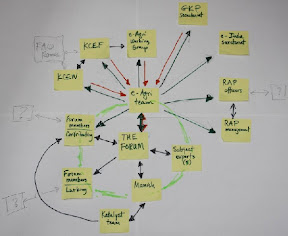
One of the major challenges was deciding whether to map individuals, organizations, or some combination of both. In the end I have a combination, a combination that changed as I progressed through the assignment. Ultimately I chose to go with more organizational groups and fewer individuals mainly to make mapping different lines of communication a simpler process. But then this led to questions, and more questions by a colleague and facilitator.
1) What about the individuals & related communication flows we know exist, but cannot "see" and thus cannot map?
2) What are the pros, cons of mapping individuals versus mapping organizations/groups?
3) What happens to the lines in a map when an individual moves in/out of a particular position within an organization?
I think the answer to question 1 is that these can be elucidated by different means, so part of the exercise is determining if it is necessary/worthwhile to make the effort.
Points 2 and 3 are interlinked. But I'm having a hard time rationalizing the individual/organization relationship. I think (but need some help on this) that it's the individual that is responsible for the communication/KS so that the individual is key. And that individuals moving from position to position (inter- or intra-organizationally) move their communication lines with them, but by necessity evolve those lines based on their new environment. Thus the organization is the environment ... enabling or otherwise. Hmm....
One of the major challenges was deciding whether to map individuals, organizations, or some combination of both. In the end I have a combination, a combination that changed as I progressed through the assignment. Ultimately I chose to go with more organizational groups and fewer individuals mainly to make mapping different lines of communication a simpler process. But then this led to questions, and more questions by a colleague and facilitator.
1) What about the individuals & related communication flows we know exist, but cannot "see" and thus cannot map?
2) What are the pros, cons of mapping individuals versus mapping organizations/groups?
3) What happens to the lines in a map when an individual moves in/out of a particular position within an organization?
I think the answer to question 1 is that these can be elucidated by different means, so part of the exercise is determining if it is necessary/worthwhile to make the effort.
Points 2 and 3 are interlinked. But I'm having a hard time rationalizing the individual/organization relationship. I think (but need some help on this) that it's the individual that is responsible for the communication/KS so that the individual is key. And that individuals moving from position to position (inter- or intra-organizationally) move their communication lines with them, but by necessity evolve those lines based on their new environment. Thus the organization is the environment ... enabling or otherwise. Hmm....
31 March 2008
Sharing Knowledge with me and others (a course!)
I am currently a participant in a workshop on knowledge sharing (KS) techniques supported by CGIAR and facilitated by four great individuals. A professional development opportunity!! Wonderful.
The success of this could be judged through my application of the things we learn in my work and hopefully through the identification of some common interests (maybe even specific projects?) with others who are taking the course with me.
(This is the first of several posts that I will be making during the online KS workshop.)
The success of this could be judged through my application of the things we learn in my work and hopefully through the identification of some common interests (maybe even specific projects?) with others who are taking the course with me.
LEARNING! Never stop learning.
(This is the first of several posts that I will be making during the online KS workshop.)
Subscribe to:
Posts (Atom)