I find myself struggling with something here, and would love some feedback.
Suddenly I am not so comfortable with all the "m" terms that are starting to pop up, m-banking, m-learning, and in particular m-agriculture. This last one is a relative unknown - the only use I've seen of it up until this week has been by MobileActive (who I have a lot of respect for, by the way). I don't challenge the intent of those using the terms, but wonder if we are doing the correct thing by creating another set of terminology, when even many of the "e" terms still have diffuse definitions.
Also in talking with several people I collaborate with, I find the "m" may indicate a specific focus on the wireless, movable technology. On one hand, if we come to a common understanding that this is the case, then I will be more content. When I read an explaination of m-learning I think this may be the point of using the term. (Considering my own interests and focusing on the specific case of "m-agriculture" I do not find a definition. The closest I have found so far is "m-development", but I am not trying to substitute one for the other.) Yet there is still a part of me that wonders if this terminology isn't more about trending.
I realize that mobile technology is in the forefront of the ICT arsenal at the moment - indeed I've facilitated discussions on the use of mobile technology in rural development, and participate in panels about this next week. However, I really think what is important is the impact on development issues, how processes are modified and enhanced (or new ones created) for better outcomes, not the technology per se.
What do you think? Do we need both "e" and "m" terms to add value to our discussions and work in using ICT for development? When is it important to distinguinsh between technologise, versus the way people use and understand a technology? Am I making a mountian out of a molehill? :-) I would be greatful for any thoughts.
Showing posts with label learning. Show all posts
Showing posts with label learning. Show all posts


09 September 2008
Twitter Experiment at IAALD World Congress 2008 a Great Success!
Well, simply put I am now officially a Twitter fan ... is there a term for this? Am I a “Twitterite” or a “Twitteree” or something like that?
You will know if you've read a few of my blog postings from last month that I started experimenting with Twitter, which was an idea that came into my head while taking the CGIAR-FAO Knowledge Sharing workshop earlier this year. Although initially I was quite skeptical that “microblogging” could provide enough information to be truly useful.
As timing would have it (serendipity anyone?) just after I subscribed to Twitter, Nancy White went to New Zealand to attend the Distance Education Association of New Zealand (DEANZ) 2008 Conference and was twittering the event with the tag “DEANZ08”. Suddenly I realized I had insight into a conference that I wasn’t attending and frankly hadn’t even been on my radar. Better yet, even though I didn’t attend the conference through Nancy’s tweets I got some nuggets of interest that I followed up (Googled in fact) to learn more about on my own. Then came the IAALD-AFITA-WCCA World Congress 2008, for which the tag “aginfo8” was coined by Peter Balantyne, and one of the panels I participated in was to discuss the use of cellular telephones in the development setting, and well, I was inspired. This was my chance to run a little experiment of my own to see if Twitter really was worth my time.
I started by twittering the conference. Just putting up one or two “tweets” per session that I attended, highlighting something I thought was key or interesting. I have feedback from people following me on Twitter that this was appreciated: (an example from my Twitter)
The third day of the conference was the plenary e-Agriculture panel. So that morning (early Japan time) I asked a question on Twitter about the use of cell phones in the ICT4D area. Guess what? I got replies and I referenced one reply (below) as an example while I was on the panel.

Me Twittering during the panel discussion.
(Photo Credit: Shehzaad Shams)
My colleague Gauri was also using Twitter at the conference. When the IAALD web 2.0 team found out about this, they interviewed us and posted the short video clip. (I think the video is a pretty awful image of me – strangely that little camera made me more uncomfortable than a room full of people! But content wise it is pretty good.)
There are some limitations with Twitter, mainly arising from two issues, both of which the Twitter developers are very forthright in addressing on their website/blog. First, the service has gotten popular enough that the servers exceed capacity at times and one has to be a bit patient to get data. Second, there is a limitation on who can receive outgoing SMS based on the country your SIM card is registered in. In Thailand, where I live, we cannot get SMS updates. Those limitations aside, this is a great service, and in time I think (hope!) these limitations will be addressed.
Twitter on!
You will know if you've read a few of my blog postings from last month that I started experimenting with Twitter, which was an idea that came into my head while taking the CGIAR-FAO Knowledge Sharing workshop earlier this year. Although initially I was quite skeptical that “microblogging” could provide enough information to be truly useful.
As timing would have it (serendipity anyone?) just after I subscribed to Twitter, Nancy White went to New Zealand to attend the Distance Education Association of New Zealand (DEANZ) 2008 Conference and was twittering the event with the tag “DEANZ08”. Suddenly I realized I had insight into a conference that I wasn’t attending and frankly hadn’t even been on my radar. Better yet, even though I didn’t attend the conference through Nancy’s tweets I got some nuggets of interest that I followed up (Googled in fact) to learn more about on my own. Then came the IAALD-AFITA-WCCA World Congress 2008, for which the tag “aginfo8” was coined by Peter Balantyne, and one of the panels I participated in was to discuss the use of cellular telephones in the development setting, and well, I was inspired. This was my chance to run a little experiment of my own to see if Twitter really was worth my time.
I started by twittering the conference. Just putting up one or two “tweets” per session that I attended, highlighting something I thought was key or interesting. I have feedback from people following me on Twitter that this was appreciated: (an example from my Twitter)
- gervis @mongkolroek thank you Michael for keeping us posted by a #aginfo98 report and thank youu @nancywhite for pointing to the JAALD tweets 11:12 AM August 27, 2008 from web
The third day of the conference was the plenary e-Agriculture panel. So that morning (early Japan time) I asked a question on Twitter about the use of cell phones in the ICT4D area. Guess what? I got replies and I referenced one reply (below) as an example while I was on the panel.
- Argentina provides a good case of mobilization of farmers supported by mobiles to organize the strike against govn't in food prices crisis 07:29 AM August 27, 2008

Me Twittering during the panel discussion.
(Photo Credit: Shehzaad Shams)
My colleague Gauri was also using Twitter at the conference. When the IAALD web 2.0 team found out about this, they interviewed us and posted the short video clip. (I think the video is a pretty awful image of me – strangely that little camera made me more uncomfortable than a room full of people! But content wise it is pretty good.)
There are some limitations with Twitter, mainly arising from two issues, both of which the Twitter developers are very forthright in addressing on their website/blog. First, the service has gotten popular enough that the servers exceed capacity at times and one has to be a bit patient to get data. Second, there is a limitation on who can receive outgoing SMS based on the country your SIM card is registered in. In Thailand, where I live, we cannot get SMS updates. Those limitations aside, this is a great service, and in time I think (hope!) these limitations will be addressed.
Twitter on!
20 August 2008
Meeting of Minds, Sharing of Knowledge: e-Agriculture next week in Japan
e-Agriculture at the IAALD-AFITA-WCCA World Conference
I'm looking forward to joining the World Conference next week. It is a great opportunity that all three organizations have joined together for this conference, as I am sure it will not only bring together a large group of people from around the world dedicated to the application of ICT in development, but will also bring together a wide cross-section of experiences, knowledge and perspectives, from organizational capacity building to IT infrastructure, from metadata standards to community KS forums. It is this opportunity to interact and form new relationships, share knowledge and extend our personal networks that will be the great value at the end of the four days.
The conference takes place 24-27 August 2008 in Atsugi, Japan at the Tokyo University of Agriculture. The e-Agriculture plenary session will be on Wednesday, 27 August, from 11:00 AM to 12:30 PM. I really believe in the e-Agriculture initiative and am pleased that I was asked to participate in this event.
Information from the e-Agriculture news flash sent out yesterday notes:
Launch of CIARD
There will also be a plenary session on the 27th to launch CIARD, the Coherence in Information for Agricultural Research for Development. Earlier this year, a group of organizations from around the world got together to establish this initiative, which aims to make agricultural research information publicly available and accessible to all. Several of the founding partners will be present to help launch CIARD with all the World Congress' participants this day.
I'm looking forward to joining the World Conference next week. It is a great opportunity that all three organizations have joined together for this conference, as I am sure it will not only bring together a large group of people from around the world dedicated to the application of ICT in development, but will also bring together a wide cross-section of experiences, knowledge and perspectives, from organizational capacity building to IT infrastructure, from metadata standards to community KS forums. It is this opportunity to interact and form new relationships, share knowledge and extend our personal networks that will be the great value at the end of the four days.
The conference takes place 24-27 August 2008 in Atsugi, Japan at the Tokyo University of Agriculture. The e-Agriculture plenary session will be on Wednesday, 27 August, from 11:00 AM to 12:30 PM. I really believe in the e-Agriculture initiative and am pleased that I was asked to participate in this event.
Information from the e-Agriculture news flash sent out yesterday notes:
The UN Food and Agriculture Organization (FAO) will facilitate an e-Agriculture panel to deliberate issues of ICT as enablers in various critical areas of development, as well as the role of Public Private Partnerships (PPP) in support of e-Agriculture.
The session will be an interactive discussion with the audience, with the panel anchored by:
- Alexander Flor, Dean, Faculty of Information and Communication Studies, UPOU;
- Manish Pandey, Deputy General Manager, Katalyst-Swisscontact;
- Michael Riggs, Information Management Specialist, FAO RAP;
- Roxanna Samii, International Fund for Agricultural Development;
and Stephen Rudgard, FAO, as the moderator.
The panelists will share knowledge and experiences, and the audience encouraged to contribute on topics such as the use of mobile telephony use in rural areas, with particular reference to ameliorate global soaring food prices, and knowledge brokering services in support of agricultural development, including Communities of Practice and approaches to building capacity.
There will also be a reprise of the issues arising in this year’s PPP online forum and eIndia conference discussion session entitled "Making e-Agriculture Work through Public Private Partnership in Asia". Experience and lessons in Bangladesh (Katalyst) and West Africa (Tradenet) will be contributed.
Full details of the PPP online forum, and reviews of the two sessions organized by FAO, the Global Knowledge Partnership (GKP), OneWorld South Asia and Katalyst in the e-Agriculture track of India's largest ICT Event, eIndia 2008 in July 2008, can be found on www.e-agriculture.org.
For more information on IAALD-AFITA-WCCA World Conference please see http://iaald-afita-wcca2008.org/
Launch of CIARD
There will also be a plenary session on the 27th to launch CIARD, the Coherence in Information for Agricultural Research for Development. Earlier this year, a group of organizations from around the world got together to establish this initiative, which aims to make agricultural research information publicly available and accessible to all. Several of the founding partners will be present to help launch CIARD with all the World Congress' participants this day.
16 July 2008
Looking Towards e-Agriculture at eIndia 2008!
The next main ICT4D event in this region will be eIndia 2008, 29-31 July, in New Delhi.
In the eAgriculture track at eIndia, FAO, GKP and OneWorld South Asia have teamed up to bring some of the brightest minds in KM4D and ICT4D together at this event, people dedicated to improving rural development. The group will discuss some new topics, shine the light on some challenges, and see what innovative ideas the collective group can identify for acting on in the near future.
There will be a headline presenation on the global e-Agriculture initiative and the growing importance of the e-agriculture.org platform in Asia-Pacific.
On Wednesday, 30 July there will be a panel discussion on "Making e-Agriculture work through public-private partnership in Asia."Public private partnerships (PPPs) in e-Agriculture are generally found at the community level where the strengths of the public and private sectors complement each other in providing information and advisory services that address the needs of farmers and rural communities. Examples of PPP in e-Agriculture abound in Asia-Pacific, and range from establishing access points (e.g. cybercafés, telecenters) to generation and delivery of content through mobile phones (SMS) and the internet. Understanding why a PPP is required, the respective mandates and incentives of the partners, and their roles in the partnership, are fundamental to its success. This face-to-face event builds on the March 2008 online forum hosted by www.e-agriculture.org with an audience led discussion on how to further this understanding, and to identify opportunities for collaboration.
Panelists:
- Dr. Alexander Flor, Dean & Professor, Faculty of Information and Communication Studies, University of the Philippines Open Univ.
- Mr. Michael Riggs, e-Agriculture.org
- Mr. Rikin Gandhi, Assistant Researcher, Microsoft Research India; Founding Member, Digital Green
- Dr. (Ms) Prema Ramchandran, Director, Nutrition Foundation of India
Moderated by Ms. Shalini Kala, IDRC, ENRAP coordinator
And so much more!! It's a chance to listen, learn, speak, meet and network ... all key to personal knowledge sharing! I hope to see you there. Do come up and say "hi" when you see me! ;-)
In the eAgriculture track at eIndia, FAO, GKP and OneWorld South Asia have teamed up to bring some of the brightest minds in KM4D and ICT4D together at this event, people dedicated to improving rural development. The group will discuss some new topics, shine the light on some challenges, and see what innovative ideas the collective group can identify for acting on in the near future.
There will be a headline presenation on the global e-Agriculture initiative and the growing importance of the e-agriculture.org platform in Asia-Pacific.
On Wednesday, 30 July there will be a panel discussion on "Making e-Agriculture work through public-private partnership in Asia."Public private partnerships (PPPs) in e-Agriculture are generally found at the community level where the strengths of the public and private sectors complement each other in providing information and advisory services that address the needs of farmers and rural communities. Examples of PPP in e-Agriculture abound in Asia-Pacific, and range from establishing access points (e.g. cybercafés, telecenters) to generation and delivery of content through mobile phones (SMS) and the internet. Understanding why a PPP is required, the respective mandates and incentives of the partners, and their roles in the partnership, are fundamental to its success. This face-to-face event builds on the March 2008 online forum hosted by www.e-agriculture.org with an audience led discussion on how to further this understanding, and to identify opportunities for collaboration.
Panelists:
- Mr. Amit Dasgupta, IBM Global Services India
- Mr. Manish Pandey, Deputy General Manager , Katalyst-Swisscontact
- Mr. Naimur Rahman, Director, OneWorld South Asia
- Mr. Manish Pandey, Deputy General Manager , Katalyst-Swisscontact
- Mr. Naimur Rahman, Director, OneWorld South Asia
- Dr. (Mr) N.T. Yaduraju, NAIP/ICAR
- Dr. (Ms) Amrita Patel, Chairman, National Dairy Development Board (TBC)
- Dr. (Ms) Amrita Patel, Chairman, National Dairy Development Board (TBC)
Moderated by Michael Riggs, FAO
On Thursday, 31 July there will be a panel discussion on "The role of communities of practice (COP) and networks in e-Agriculture." COP strengthen links between networks of practitioners, allow individuals to gather and gain access to policy and technical information, facilitate sharing and exchange of complementary knowledge and resources, and can organize and create knowledge in ways that are flexible. Following up the World Summit on the Information Society (WSIS) plan of action, the e-Agriculture Working Group conducted a global survey on "e-agriculture". The need for networks of experts and a community of practice was high on the resulting list of actions. This panel representing some of the leading COP in Asia that are active through virtual collaboration spaces, face-to-face events, and in-country interventions. The panel will interact with the audience to analyze what role COP play and what value they bring to the application of e-Agriculture and through that successful, sustainable rural development in the region.
Panelists:
- Dr. Gopi Ghosh, Assistant FAO Representative, and Solution Exchange India network coordinatorOn Thursday, 31 July there will be a panel discussion on "The role of communities of practice (COP) and networks in e-Agriculture." COP strengthen links between networks of practitioners, allow individuals to gather and gain access to policy and technical information, facilitate sharing and exchange of complementary knowledge and resources, and can organize and create knowledge in ways that are flexible. Following up the World Summit on the Information Society (WSIS) plan of action, the e-Agriculture Working Group conducted a global survey on "e-agriculture". The need for networks of experts and a community of practice was high on the resulting list of actions. This panel representing some of the leading COP in Asia that are active through virtual collaboration spaces, face-to-face events, and in-country interventions. The panel will interact with the audience to analyze what role COP play and what value they bring to the application of e-Agriculture and through that successful, sustainable rural development in the region.
Panelists:
- Dr. Alexander Flor, Dean & Professor, Faculty of Information and Communication Studies, University of the Philippines Open Univ.
- Mr. Michael Riggs, e-Agriculture.org
- Mr. Rikin Gandhi, Assistant Researcher, Microsoft Research India; Founding Member, Digital Green
- Dr. (Ms) Prema Ramchandran, Director, Nutrition Foundation of India
Moderated by Ms. Shalini Kala, IDRC, ENRAP coordinator
And so much more!! It's a chance to listen, learn, speak, meet and network ... all key to personal knowledge sharing! I hope to see you there. Do come up and say "hi" when you see me! ;-)
04 April 2008
The Medium and the Message
Aaarg! I fear another one of these "chicken and egg" issues...
Vanessa, a member of my KS workshop asked this critical question:
Personally I have been frustrated for years now by the question "WHO?" is responsible for tailoring all the information that is already readily available to those who need it. I’ve come to the conclusion it is something of a rhetorical questions resulting from varying levels of understanding of KM/KS principles amongst users, unequal allocation of KS resources, and a history of an “if we build it they will come” attitude about information management, amongst other things. Does anyone have a different take on this?
As for methods, this also needs to be "appropriate" as was noted in our workshop’s conference call this morning when someone raised the issue of how a choice of tools could actually bias the outcome of an exercise. (The example was mapping software in which it is intrinsically easier to create hub-and-spoke type relationships over other forms of networks.)
Personally I find that working on a computer is not conducive to group work. I'm not being a Luddite here! I just observe that for some reason when a group is around a computer most people tend to sit back and observe while the one or two people with their hands on the mouse do most of the actual thinking. Whereas working on a big sheet of paper with post-its is something that everyone can interact with simultaneously and thus there is more collaborative thinking. The computer-based tools are more useful for iterative work.
First hand experiencing with these is what we really need to start making informed choices. Thank goodness for workshops like this one that I’m in. Networks of practitioners were also pointed out as good ways to get experience with some of the methods. For example:
http://www.theworldcafe.net
http://www.openspaceworld.org
This is a very complicate subject, and something I need to look into and learn more about with the help of my colleagues and friends.
Vanessa, a member of my KS workshop asked this critical question:
What is the relationship between knowing your audience and communicating to them? If we want to communicate results to policymakers, the private sector and donors... do we take a different approach for each stakeholder? do we change the medium or just the message?The message has to be tailored to the audience, this I believe just from my own professional experience. FAO’s technical publications on climate change are not suited to children studying climate change in grade school. Research journals on climate change may not necessarily give policy makers information in a form they can use for decision making. The impact of climate change is different from the perspective of a local NGO versus an international organization.
Personally I have been frustrated for years now by the question "WHO?" is responsible for tailoring all the information that is already readily available to those who need it. I’ve come to the conclusion it is something of a rhetorical questions resulting from varying levels of understanding of KM/KS principles amongst users, unequal allocation of KS resources, and a history of an “if we build it they will come” attitude about information management, amongst other things. Does anyone have a different take on this?
As for methods, this also needs to be "appropriate" as was noted in our workshop’s conference call this morning when someone raised the issue of how a choice of tools could actually bias the outcome of an exercise. (The example was mapping software in which it is intrinsically easier to create hub-and-spoke type relationships over other forms of networks.)
Personally I find that working on a computer is not conducive to group work. I'm not being a Luddite here! I just observe that for some reason when a group is around a computer most people tend to sit back and observe while the one or two people with their hands on the mouse do most of the actual thinking. Whereas working on a big sheet of paper with post-its is something that everyone can interact with simultaneously and thus there is more collaborative thinking. The computer-based tools are more useful for iterative work.
First hand experiencing with these is what we really need to start making informed choices. Thank goodness for workshops like this one that I’m in. Networks of practitioners were also pointed out as good ways to get experience with some of the methods. For example:
http://www.theworldcafe.net
http://www.openspaceworld.org
This is a very complicate subject, and something I need to look into and learn more about with the help of my colleagues and friends.
03 April 2008
The Individual or the Organization: Which Matters for Effective Knowledge Sharing?
In the KS workshop we had an exercise to map a network (see the image of my work below). I chose to map a network in the e-Agriculture community that I am working with, based on an online forum/discussion group. It may go down in the history books as "easier said than done"!
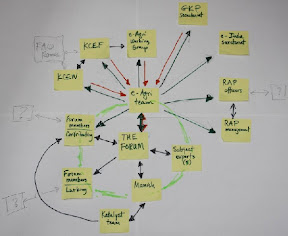
One of the major challenges was deciding whether to map individuals, organizations, or some combination of both. In the end I have a combination, a combination that changed as I progressed through the assignment. Ultimately I chose to go with more organizational groups and fewer individuals mainly to make mapping different lines of communication a simpler process. But then this led to questions, and more questions by a colleague and facilitator.
1) What about the individuals & related communication flows we know exist, but cannot "see" and thus cannot map?
2) What are the pros, cons of mapping individuals versus mapping organizations/groups?
3) What happens to the lines in a map when an individual moves in/out of a particular position within an organization?
I think the answer to question 1 is that these can be elucidated by different means, so part of the exercise is determining if it is necessary/worthwhile to make the effort.
Points 2 and 3 are interlinked. But I'm having a hard time rationalizing the individual/organization relationship. I think (but need some help on this) that it's the individual that is responsible for the communication/KS so that the individual is key. And that individuals moving from position to position (inter- or intra-organizationally) move their communication lines with them, but by necessity evolve those lines based on their new environment. Thus the organization is the environment ... enabling or otherwise. Hmm....
One of the major challenges was deciding whether to map individuals, organizations, or some combination of both. In the end I have a combination, a combination that changed as I progressed through the assignment. Ultimately I chose to go with more organizational groups and fewer individuals mainly to make mapping different lines of communication a simpler process. But then this led to questions, and more questions by a colleague and facilitator.
1) What about the individuals & related communication flows we know exist, but cannot "see" and thus cannot map?
2) What are the pros, cons of mapping individuals versus mapping organizations/groups?
3) What happens to the lines in a map when an individual moves in/out of a particular position within an organization?
I think the answer to question 1 is that these can be elucidated by different means, so part of the exercise is determining if it is necessary/worthwhile to make the effort.
Points 2 and 3 are interlinked. But I'm having a hard time rationalizing the individual/organization relationship. I think (but need some help on this) that it's the individual that is responsible for the communication/KS so that the individual is key. And that individuals moving from position to position (inter- or intra-organizationally) move their communication lines with them, but by necessity evolve those lines based on their new environment. Thus the organization is the environment ... enabling or otherwise. Hmm....
Subscribe to:
Posts (Atom)