I found a very interesting article "Ten Reasons Gen Xers are Unhappy at Work" (It comes from the author's larger group of online discussions on Gen X and Y management issues. The site is a new find for me, and as I find it quite interesting I am sharing.)
By the way, I guess I should divulge that I am part of Gen X.
We will get to ICT, but first let me say it is very interesting to read analysis about managing different generations. If one generalizes about my workplace, my superiors are mostly Boomers, my peers are Gen X, and the newer staff are Gen Y. Quite a conundrum!
Recently I was told that Gen Y has proclaimed itself renamed the "Millennium Generation." Hmm ... I mean they were hardly even old enough to worry about their Windows files exploding on the "doom" date of 01/01/00!
Getting back to the issue at hand, there are some very useful tidbits - points 5, 6 & 8 - in this article about how the different generations relate to new technologies and also how they communicate. Both of these issues are critical to successful application of ICT for development (or in any context really). It may be possible to argue this is written from a the perspective of a western manger, and while I agree adamantly that awareness and understanding of cultural context is critical, I still find the considerations and sensitivities made apparent by this author's writings applicable here in Asia.
We must be aware of how different groups of people relate to each other and to technology. Generalizations are useful tools in developing models to handle such situations (and as such I disagree with some of the detractors of this article). We have to start somewhere, and an informed generalization combined with experience and skill (wisdom?!) can lead to the successful adaption of good ICT4D models in our day-to-day, real world projects and programs.
21 May 2008


07 May 2008
Human Capacity Building Efforts of FAO and Others Brought to a New Focus Online
The role of capacity building is essential to knowledge management and sharing, and of crucial importance in the development field. Without an understanding of both the information that is available to us as well as the tools and methodologies to organize and make use of this information, it cannot have a positive impact and we get nowhere.
FAO says c

The portal highlights:
There are links to FAO's own featured capacity building sites, to other initiatives in the UN, and to the broader international development community’s efforts. I encourage the ICT4D community to try this site in order to identify new capacity building resources and tools.
FAO says c

The portal highlights:
- Learning Resources, both corporate and specialized collections
- Learning Services, searchable by keyword and topic and providing access to FAO's Fellowships/Funding Sources database
- Featured Sites highlighting specific initiatives in capacity building
There are links to FAO's own featured capacity building sites, to other initiatives in the UN, and to the broader international development community’s efforts. I encourage the ICT4D community to try this site in order to identify new capacity building resources and tools.
18 April 2008
Learning never stops!
Some spontaneous thoughts on PLN ... Nancy White's bookmarks on del.icio.us just showed up with something about "PLN"and somehow it occurred to me that I needed to know what this meant. Timely really, as I read this article on David Warlick's blog, because I am just wrapping up a four week online course on knowledge sharing, which I now realize is a clear example of my PLN, my "Personal Learning Network."
Learning is next to godliness ... somehow my PLN of my early years managed to sink that value deep into me. Although caught up in the day-to-day demands of large organizations and professional "carrots and sticks," I think it becomes possible to lose track of this. PLN play a vital role not only for one self, but also for others as:
My mind has already got me thinking of how the Web2.0 technologies will impact our PLN. The article talks about Twitter.
Personally I'm fascinated thinking of the cultural and organizational impact of technology such as Twitter ... an enclosed classroom or meeting room, or a delimited group of individuals, is suddenly opened up to the Global Village. Of course opening up can be good or bad, depending on one's perspective. Not all would be comfortable with, welcome, or find value in this level of exposure. I doubt there will be Twittering in my office's meetings anytime soon!
It would seem there is the potential for too much of a good thing here, although Twitter's website does say it is the "modern antidote to information overload." There certainly is a need for limiting or filtering, and this is why the role of an established, defined networks is so very important.
But the potential for valuable input is phenomenal.
Learning is next to godliness ... somehow my PLN of my early years managed to sink that value deep into me. Although caught up in the day-to-day demands of large organizations and professional "carrots and sticks," I think it becomes possible to lose track of this. PLN play a vital role not only for one self, but also for others as:
- part of our own "continuing education" for professional and personal development
- something to be instilled in others; key role in mentoring and managing
My mind has already got me thinking of how the Web2.0 technologies will impact our PLN. The article talks about Twitter.
Personally I'm fascinated thinking of the cultural and organizational impact of technology such as Twitter ... an enclosed classroom or meeting room, or a delimited group of individuals, is suddenly opened up to the Global Village. Of course opening up can be good or bad, depending on one's perspective. Not all would be comfortable with, welcome, or find value in this level of exposure. I doubt there will be Twittering in my office's meetings anytime soon!
It would seem there is the potential for too much of a good thing here, although Twitter's website does say it is the "modern antidote to information overload." There certainly is a need for limiting or filtering, and this is why the role of an established, defined networks is so very important.
But the potential for valuable input is phenomenal.
16 April 2008
Knowledge Societies and Governance in Asia
I was recently invited to speak at a conference that considered the development of knowledge societies in Asia, and how this development has an impact on economies and in particular governance. It was a very interesting (and for me very unusual) gathering of individuals from academia, government, the private sector and development organizations.
There were some fascinating presentations on the impact of cultural diversity on knowledge sharing, efforts to quantify the impact of ICT on development and economic growth, projects to alleviate poverty and food insecurity with ICT, successes and failures in large scale knowledge management practices, national case studies, and many other topics. It was both a good opportunity to network with colleagues, and also a chance to learn both theory and practice from some leading thinkers in the knowledge management field.
This all took place under the banner of the Fourth International Research Conference on Asian Business - Knowledge Architectures for Development: Challenges Ahead for Business and Governance and was held at Singapore Management University, 24-25 March 2008.
Further information is available on the conference website.
There were some fascinating presentations on the impact of cultural diversity on knowledge sharing, efforts to quantify the impact of ICT on development and economic growth, projects to alleviate poverty and food insecurity with ICT, successes and failures in large scale knowledge management practices, national case studies, and many other topics. It was both a good opportunity to network with colleagues, and also a chance to learn both theory and practice from some leading thinkers in the knowledge management field.
This all took place under the banner of the Fourth International Research Conference on Asian Business - Knowledge Architectures for Development: Challenges Ahead for Business and Governance and was held at Singapore Management University, 24-25 March 2008.
Further information is available on the conference website.
04 April 2008
The Medium and the Message
Aaarg! I fear another one of these "chicken and egg" issues...
Vanessa, a member of my KS workshop asked this critical question:
Personally I have been frustrated for years now by the question "WHO?" is responsible for tailoring all the information that is already readily available to those who need it. I’ve come to the conclusion it is something of a rhetorical questions resulting from varying levels of understanding of KM/KS principles amongst users, unequal allocation of KS resources, and a history of an “if we build it they will come” attitude about information management, amongst other things. Does anyone have a different take on this?
As for methods, this also needs to be "appropriate" as was noted in our workshop’s conference call this morning when someone raised the issue of how a choice of tools could actually bias the outcome of an exercise. (The example was mapping software in which it is intrinsically easier to create hub-and-spoke type relationships over other forms of networks.)
Personally I find that working on a computer is not conducive to group work. I'm not being a Luddite here! I just observe that for some reason when a group is around a computer most people tend to sit back and observe while the one or two people with their hands on the mouse do most of the actual thinking. Whereas working on a big sheet of paper with post-its is something that everyone can interact with simultaneously and thus there is more collaborative thinking. The computer-based tools are more useful for iterative work.
First hand experiencing with these is what we really need to start making informed choices. Thank goodness for workshops like this one that I’m in. Networks of practitioners were also pointed out as good ways to get experience with some of the methods. For example:
http://www.theworldcafe.net
http://www.openspaceworld.org
This is a very complicate subject, and something I need to look into and learn more about with the help of my colleagues and friends.
Vanessa, a member of my KS workshop asked this critical question:
What is the relationship between knowing your audience and communicating to them? If we want to communicate results to policymakers, the private sector and donors... do we take a different approach for each stakeholder? do we change the medium or just the message?The message has to be tailored to the audience, this I believe just from my own professional experience. FAO’s technical publications on climate change are not suited to children studying climate change in grade school. Research journals on climate change may not necessarily give policy makers information in a form they can use for decision making. The impact of climate change is different from the perspective of a local NGO versus an international organization.
Personally I have been frustrated for years now by the question "WHO?" is responsible for tailoring all the information that is already readily available to those who need it. I’ve come to the conclusion it is something of a rhetorical questions resulting from varying levels of understanding of KM/KS principles amongst users, unequal allocation of KS resources, and a history of an “if we build it they will come” attitude about information management, amongst other things. Does anyone have a different take on this?
As for methods, this also needs to be "appropriate" as was noted in our workshop’s conference call this morning when someone raised the issue of how a choice of tools could actually bias the outcome of an exercise. (The example was mapping software in which it is intrinsically easier to create hub-and-spoke type relationships over other forms of networks.)
Personally I find that working on a computer is not conducive to group work. I'm not being a Luddite here! I just observe that for some reason when a group is around a computer most people tend to sit back and observe while the one or two people with their hands on the mouse do most of the actual thinking. Whereas working on a big sheet of paper with post-its is something that everyone can interact with simultaneously and thus there is more collaborative thinking. The computer-based tools are more useful for iterative work.
First hand experiencing with these is what we really need to start making informed choices. Thank goodness for workshops like this one that I’m in. Networks of practitioners were also pointed out as good ways to get experience with some of the methods. For example:
http://www.theworldcafe.net
http://www.openspaceworld.org
This is a very complicate subject, and something I need to look into and learn more about with the help of my colleagues and friends.
03 April 2008
The Individual or the Organization: Which Matters for Effective Knowledge Sharing?
In the KS workshop we had an exercise to map a network (see the image of my work below). I chose to map a network in the e-Agriculture community that I am working with, based on an online forum/discussion group. It may go down in the history books as "easier said than done"!
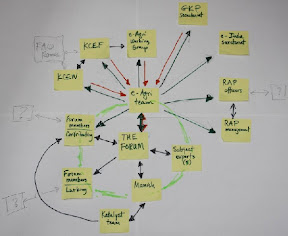
One of the major challenges was deciding whether to map individuals, organizations, or some combination of both. In the end I have a combination, a combination that changed as I progressed through the assignment. Ultimately I chose to go with more organizational groups and fewer individuals mainly to make mapping different lines of communication a simpler process. But then this led to questions, and more questions by a colleague and facilitator.
1) What about the individuals & related communication flows we know exist, but cannot "see" and thus cannot map?
2) What are the pros, cons of mapping individuals versus mapping organizations/groups?
3) What happens to the lines in a map when an individual moves in/out of a particular position within an organization?
I think the answer to question 1 is that these can be elucidated by different means, so part of the exercise is determining if it is necessary/worthwhile to make the effort.
Points 2 and 3 are interlinked. But I'm having a hard time rationalizing the individual/organization relationship. I think (but need some help on this) that it's the individual that is responsible for the communication/KS so that the individual is key. And that individuals moving from position to position (inter- or intra-organizationally) move their communication lines with them, but by necessity evolve those lines based on their new environment. Thus the organization is the environment ... enabling or otherwise. Hmm....
One of the major challenges was deciding whether to map individuals, organizations, or some combination of both. In the end I have a combination, a combination that changed as I progressed through the assignment. Ultimately I chose to go with more organizational groups and fewer individuals mainly to make mapping different lines of communication a simpler process. But then this led to questions, and more questions by a colleague and facilitator.
1) What about the individuals & related communication flows we know exist, but cannot "see" and thus cannot map?
2) What are the pros, cons of mapping individuals versus mapping organizations/groups?
3) What happens to the lines in a map when an individual moves in/out of a particular position within an organization?
I think the answer to question 1 is that these can be elucidated by different means, so part of the exercise is determining if it is necessary/worthwhile to make the effort.
Points 2 and 3 are interlinked. But I'm having a hard time rationalizing the individual/organization relationship. I think (but need some help on this) that it's the individual that is responsible for the communication/KS so that the individual is key. And that individuals moving from position to position (inter- or intra-organizationally) move their communication lines with them, but by necessity evolve those lines based on their new environment. Thus the organization is the environment ... enabling or otherwise. Hmm....
31 March 2008
Sharing Knowledge with me and others (a course!)
I am currently a participant in a workshop on knowledge sharing (KS) techniques supported by CGIAR and facilitated by four great individuals. A professional development opportunity!! Wonderful.
The success of this could be judged through my application of the things we learn in my work and hopefully through the identification of some common interests (maybe even specific projects?) with others who are taking the course with me.
(This is the first of several posts that I will be making during the online KS workshop.)
The success of this could be judged through my application of the things we learn in my work and hopefully through the identification of some common interests (maybe even specific projects?) with others who are taking the course with me.
LEARNING! Never stop learning.
(This is the first of several posts that I will be making during the online KS workshop.)
Subscribe to:
Posts (Atom)